 |  |  |  |  |
|---|
Applied Electrochemistry Lab. (Arai-Shimizu Lab.)
Electrochemistry (Electrodeposition, Intercalation, Rechargeable Batteries )
Department of Materials Chemistry, Faculty of Engineering, Shinshu University
Applied Electrochemistry Laboratory ( Arai-Shimizu Laboratory )
Department of Materials Chemistry, Faculty of Engineering, Shinshu Univ.
Creation of functional materials by composite plating
(Applications to dissimilar material joining, thermal conductivity, electrical conductivity, etc.) The following is an example.

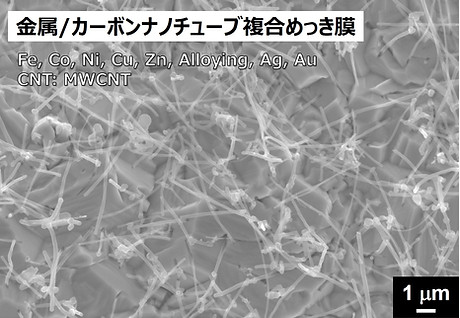
Development of Functional Materials based on Electroplating Technique
We are developing various functional materials (thermal and electrical conductors). The following is one example. Reducing CO2 emissions and conserving energy are required as measures against global warming. CO2 emissions from mobile vehicles such as automobiles account for approximately 20% of global CO2 emissions. In the automotive industry, single-plate steel bodies are prevalent, and efforts are being made to promote the appropriate use of materials in the right places and the use of multi-materials, taking advantage of the characteristics of various structural materials to lighten automobiles. By using CFRP (carbon fiber reinforced polymer), which has the dual properties of strength surpassing that of steel and light weight, as a body material, it is expected that automobiles can be lightened by approximately 55-80%, and based on this, it is possible to reduce CO2 emissions by improving fuel efficiency. In our laboratory, we are working to strengthen the adhesion between steel with a roughened surface using composite plating technology and resin.
In addition, we are developing various functional materials (thermal and electrical conductors) using composite plating methods. For example, recently, non-cyanide Ag plating baths account for approximately 20% of CO2 emissions. In the automotive industry, single-plate steel bodies are still prevalent, and there is a growing trend towards the appropriate placement of materials in the right places, utilizing the characteristics of various structural materials to reduce the weight of automobiles, and promoting multi-materialization. By using CFRP (carbon fiber reinforced polymer), which possesses both strength superior to steel and light weight, as a body material, it is expected that automobiles can be made approximately 55-80% lighter, and this could potentially reduce CO2 emissions through improved fuel efficiency.
(Refs.)
・S. Arai et al., Advanced Engineering Materials, 22 (2020) 2000739.
・S. Arai et al., Metals, 11 (2020) 591.
・S. Arai et al., Materials Letters, 261 (2020) 126993.
・S. Arai et al., Journal of The Electrochemical Society, 164 (2) (2017) D72−D74.
・S. Arai et al., Journal of The Electrochemical Society, 163(14) (2016) D774−D779.
・S. Arai et al., Journal of The Electrochemical Society, 163 (2) (2016) D54−D56.
・S. Arai et al., Journal of The Electrochemical Society, 162 (1) (2015) D68−D73.
・S. Arai et al., Surface and Coatings Technology, 254 (2015) 224−229.
・Z. Zhang et al., Journal of Alloys and Compounds, 816 (2020) 152585.
Metal electrodeposition and intercalation (Applications to battery reactions)
~From aqueous, non-aqueous, and ionic liquids (room temperature molten salts), etc.~

Rechargeable Batteries / Electrodeposition
We are conducting research on energy storage systems aimed at realizing a low-carbon society based on the effective utilization of renewable energy.
In addition, we investigate electrodeposition reactions in room-temperature molten salts, focusing on the effects of ionic liquid cation and anion structures on electrochemical behavior.
Intercalation of multivalent cations and their application to battery reactions
-1) Exploration of reversible insertion and extraction reactions of multivalent ions such as Mg²⁺, Ca²⁺, and Zn²⁺
-2) Construction of artificial SEI enabling reversible Mg deposition and dissolution
Metal electrodeposition from aqueous/non-aqueous systems and ionic liquid electrolytes (e.g., Zn)
-1) Control of Zn deposition morphology in aqueous and non-aqueous electrolytes (including room-temperature molten salts)
-2) Influence of ionic liquid cation and anion structures on Zn deposition morphology
Battery systems utilizing hydronium ions
-1) Exploration of host materials for proton insertion
-2) Development of proton-conducting electrolytes (e.g., suppression of active material dissolution)
Others
-1) Si anodes for lithium secondary batteries (e.g., impurity-doped Si prepared by the Czochralski method)
-2) Electrochemical utilization of carbonate ions and electrochemical removal of harmful ions
Refs.)
・M. Shimizu et al., The Journal of Physical Chemistry C, 127 (2023) 17677–17684.
・M. Shimizu et al., ChemElectroChem, 9 (2022) e202200016.
・M. Shimizu et al., Physical Chemistry Chemical Physics, 23 (2021) 16981-16989.
・M. Shimizu et al., ACS Applied Energy Materials, 4 (2021) 7922-7929.
・M. Shimizu et al., The Journal of Physical Chemistry C, 124 (2020) 13008–13016.
・M. Shimizu et al., RSC Advances, 9 (2019) 21939–21945.
・M. Shimizu et al., Journal of The Electrochemical Society, 166 (10) (2019) A2242–A2244.
・M. Shimizu et al., Physical Chemistry Chemical Physics, 21 (2019) 7045–7052.
・M. Shimizu et al., ACS Applied Energy Materials, 1 (2018) 6865–6870.
・M. Shimizu et al., Journal of The Electrochemical Society, 165 (13) (2018) A3212–A3214.
・M. Shimizu et al., Physical Chemistry Chemical Physics, 20 (2018) 1127–1133.
・M. Shimizu et al., ACS Omega, 2(8) (2017) 4306–4315.
・M. Shimizu et al., Physical Chemistry Chemical Physics,18 (2016) 5139−5147.
・M. Shimizu et al., The Journal of Physical Chemistry C,119(6) (2015) 2975−2982.
・M. Shimizu et al., The Journal of Physical Chemistry C, 121 (2017) 27285–27294.
・M. Shimizu et al., Materials Letters, 220 (2018) 182–185.
・M. Shimizu et al., Journal of The Electrochemical Society, 167 (2020) 070516.